Engine ProblemsJuly 16, 20267 min read
Kia & Hyundai Engine Knocking: What That Sound Means and What to Do Right Now
That rhythmic knocking sound coming from your Kia or Hyundai engine is not something to ignore. It's a distress signal — and if you walk into a dealership unprepared, they will deny your warranty claim. Here's exactly what's happening and how to protect yourself.
CG
Carl's Garage Team
Expert Automotive Guides
## Your Engine Is Asking for Help
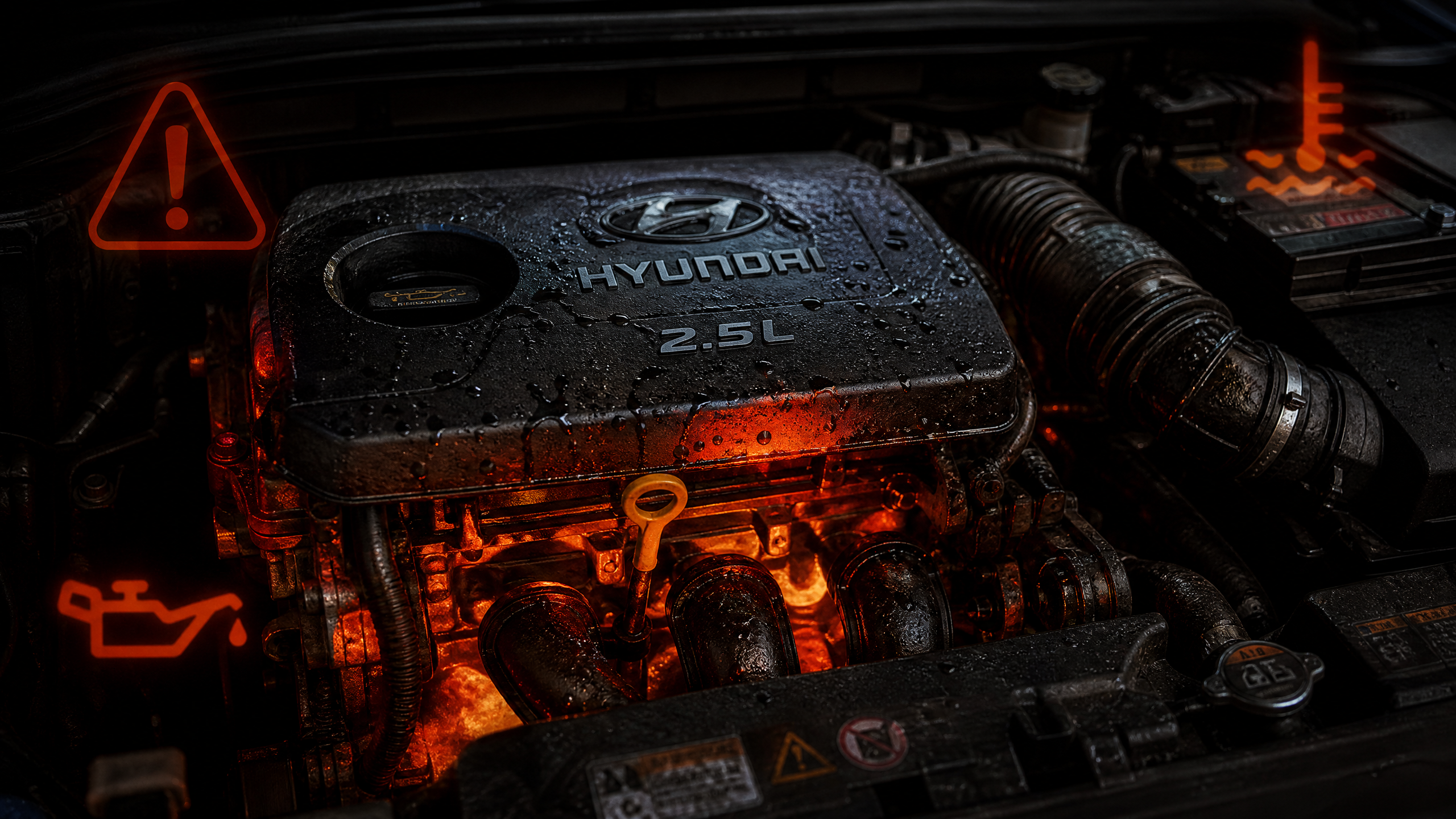
If you're hearing a rhythmic, metallic knocking sound from your Kia or Hyundai engine, your car is not trying to start a new career as a drummer. It's asking for help — and the clock is ticking.
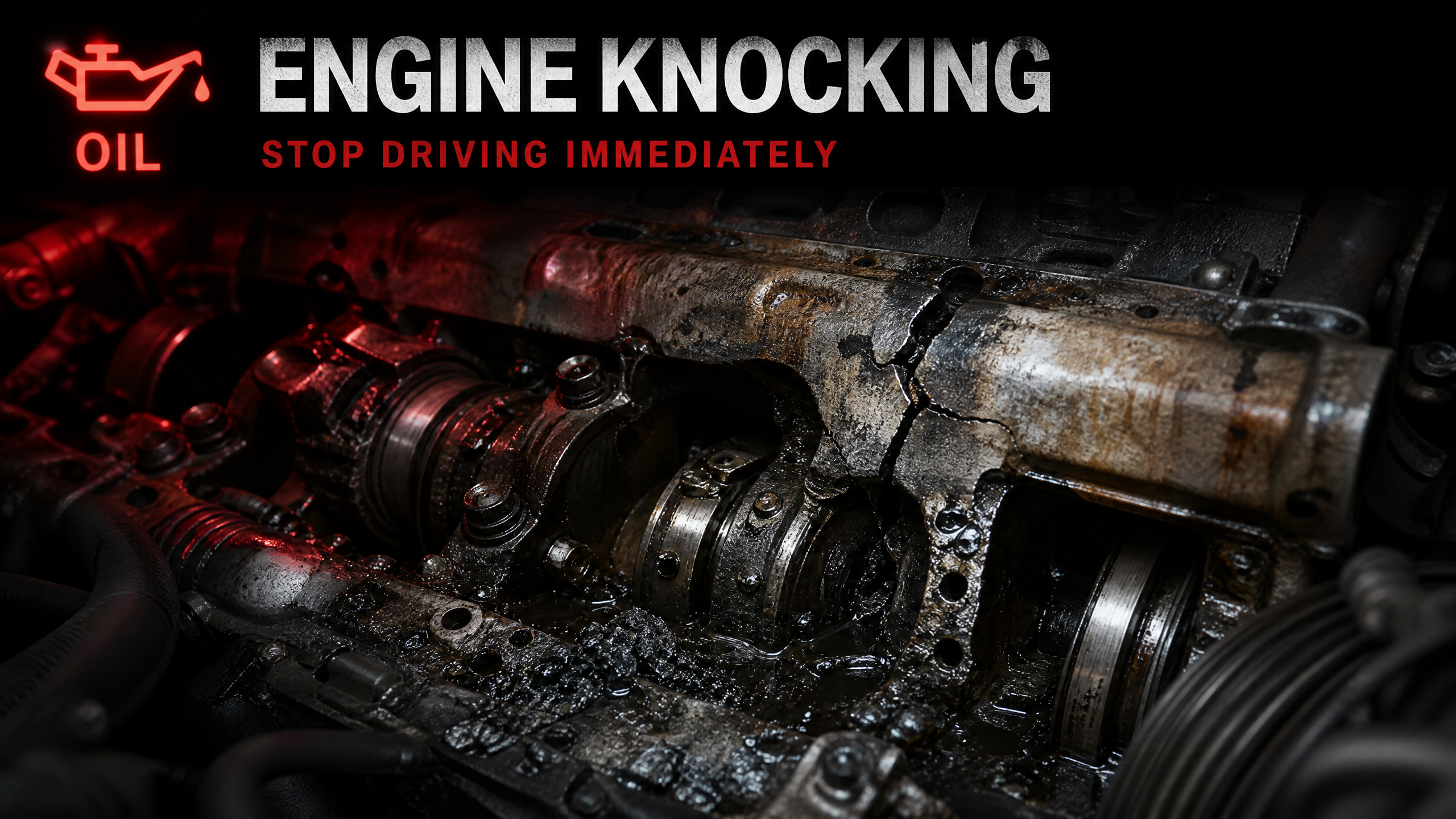
The knock happens when engine oil stops doing its job of protecting the moving parts inside your engine. Without that protective film, the bearings begin to wear down, and metal starts scraping against metal. As the saying goes: metal always wins. Your wallet, not so much.
Ignoring the sound doesn't make the problem go away. It turns your engine into a very expensive driveway decoration.
## What's Actually Happening Inside Your Engine
The Kia and Hyundai Theta II engine — found in millions of vehicles sold between 2011 and 2019 — has a well-documented defect involving the connecting rod bearings. Manufacturing debris left inside the engine during production can restrict oil flow to these bearings. Once oil pressure drops, the bearings wear rapidly, and that rhythmic knock is the sound of metal-on-metal contact that should never be happening.
This isn't a maintenance failure. It's a manufacturing defect that Kia and Hyundai have acknowledged through multiple recall campaigns and a landmark class-action settlement covering over 4 million vehicles.
## Warning Signs to Watch For
The engine knock is the most obvious symptom, but it's rarely the first. Watch for these warning signs before the knock becomes unmistakable:
- **Oil light illuminating** on your dashboard — this is your most urgent warning
- **Heavy oil consumption** — needing to add oil between changes more than normal
- **Sudden loss of power** while driving at highway speeds
- **A rhythmic knocking or ticking** that gets louder as RPMs increase
- **The vehicle stalling or stopping completely**
If you're experiencing any combination of these symptoms, stop driving the vehicle and document everything immediately.
## What to Do the Moment You Hear the Knock
This is where most owners make a costly mistake. They drive straight to the dealership without any documentation and get told their claim is denied. Don't let that happen to you.
**Step 1: Document everything before you go anywhere.**
Take photos of your dashboard — capture the oil light, any check engine lights, and the mileage. Record a video of the engine running so the knock is clearly audible. Do this immediately, while the symptoms are present.
**Step 2: Pull every maintenance receipt you have ever saved.**
Dealers will try to blame the engine failure on poor maintenance. Your oil change records are your defense. Even receipts from quick-lube shops, grocery store auto centers, or DIY oil changes with dated photos will help. The more documentation you have, the harder it is for the dealer to deny your claim.
**Step 3: Know your rights before you walk in.**
Under the Theta II settlement, covered vehicles have a **lifetime engine warranty with no mileage limit**. The settlement covers the engine block, pistons, connecting rods, and crankshaft. Dealers are legally required to honor this — but they will test whether you know that.
**Step 4: Do not accept a verbal denial.**
If the dealer says your claim is denied, ask for the denial in writing with a specific reason. A written denial is the starting point for your appeal, and dealers know that. Many denials evaporate when you ask for them in writing.
## Common Dealer Denial Tactics — and How to Counter Them
**"You didn't have the KSDS software update installed."**
The Knock Sensor Detection System (KSDS) is a software recall that monitors for bearing wear. Dealers sometimes claim it's required before they'll honor a warranty claim. It is not. The settlement does not require KSDS installation for failures that occurred before November 4, 2023. Even after that date, Hyundai's own internal Best Practice document (revised April 15, 2022) removed KSDS as a prerequisite for bearing failures.
**"Your maintenance records aren't sufficient."**
Under the Magnuson-Moss Warranty Act, the burden is on the manufacturer to prove that lack of maintenance caused the failure — not on you to prove it didn't. Regular oil changes at reasonable intervals satisfy the maintenance requirement.
**"The warranty has expired."**
The settlement provides a lifetime warranty with no mileage limit for covered engine components. There is no expiration date.
**"You're not the original owner."**
The settlement warranty transfers to subsequent owners. Your ownership status is irrelevant.
## Which Vehicles Are Covered
The following Kia and Hyundai vehicles with 2.0L and 2.4L Theta II GDI engines are covered under the settlement:
**Kia:** Optima (2011–2019), Sorento (2011–2019), Sportage (2011–2019), Soul (2012–2016, 2019), Forte (2019)
**Hyundai:** Sonata (2011–2019), Santa Fe (2013–2019), Tucson (2011–2019)
If your vehicle is on this list and you're hearing engine knock, you are almost certainly covered.
## Don't Let the Dealer Win
Kia and Hyundai dealers process hundreds of warranty claims. They know which owners will push back and which ones will walk away. The owners who come in prepared — with documentation, knowledge of the settlement terms, and a professional written response to any denial — are the ones who get their engines replaced for free.
The owners who come in unprepared are the ones who end up paying $5,000 to $8,000 out of pocket for an engine replacement that should have been free.
If your engine is knocking, don't let that knock the money out of your pocket. Use the [Kia Hyundai Recall Agent](/generate-response) to generate a professional, legally-grounded response letter tailored to your specific situation. It takes minutes and it works.
---
**Sources:**
[1] In re: Hyundai and Kia Engine Litigation II, Case No. 8:18-cv-02223-JLS-JDE, U.S. District Court, Central District of California
[2] NHTSA Recall Campaigns 20V750 (Hyundai) and 21V844 (Kia)
[3] Hyundai Motor America, "Service Campaign T3G & Warranty Extensions — Dealer Best Practice," Revised April 15, 2022
[4] Magnuson-Moss Warranty Act, 15 U.S.C. § 2301 et seq.
*This article provides information based on publicly available recall data and settlement documents. It does not constitute legal advice.*
Tags
Engine KnockTheta IIWarrantyKiaHyundaiRecall